
The Three-Step Hiring Process That Eliminates Unconscious Bias
Hiring the right people has never been just about what’s on a résumé.
For Australian business owners, leaders, and professional services firms, the real challenge often sits beneath the surface — human behaviour, motivation, bias, and fit. In a recent episode of The Bottom Line, host Sevan Tuna sat down with John Villianiotis, a specialist consultant psychologist with more than 20 years’ experience supporting boards, executives, and leadership teams to make better people decisions.
Together, they unpacked a practical hiring framework designed to reduce unconscious bias, separate “gut feel” from evidence, and improve the quality of hiring outcomes — particularly for senior appointments.
Below, we break that approach into a clear three-step hiring process Australian businesses can apply straight away.
Why Unconscious Bias Is One of the Biggest Hiring Risks
Most business leaders conduct interviews without formal training, relying heavily on intuition. Accountants can often spot strong accountants, and engineers can usually identify good engineers,
While intuition is built on experience, psychology shows us something important: as humans, we’re highly susceptible to unconscious bias.
“We are susceptible as humans to lots of biases—confirmation bias, recency bias... I like this person, but why? Is it just because I see something I like? That’s not a good criteria for a business decision.”
The 3-Step Process for Unbiased Hiring
To move from "winging it" to a professional selection process, John outlines a three-step journey designed to provide objective data.
Step 1: Define the Success Profile (Not Just the Job Description)
Many hiring processes fall over before recruitment even begins.
Businesses often know they need “a senior manager” or “a leader”, but they haven’t clearly defined what success actually looks like in that role — in their organisation. John refers to this as the success profile.
Leadership Traits: Does the role require an adaptive leader or a steady hand?
Motivators: What drives the ideal candidate? (e.g., security, achievement, or innovation?)
Cognitive Abilities: What kind of reasoning and problem-solving is required?
Step 2: Use Psychometrics Before the Interview
Interviews aren’t neutral. Candidates are usually on their best behaviour. And now, candidates also have more tools than ever to prepare. John uses a suite of accredited psychometric tools to gather data on personality, reasoning, and character traits before the deep-dive interview.
Psychometrics can help uncover:
personality traits and leadership style
cognitive reasoning and decision-making patterns
motivators and values
potential risk factors or behavioural red flags
Importantly, the point isn’t to let testing “decide” for you. It’s another source of data — one that helps reduce bias and improves the quality of questioning in the interview.
Step 3: Run a Structured Behavioural Interview
Once you’ve defined the success profile and gathered psychometric data, the interview becomes far more valuable.
People and leadership style: How the candidate works with others, influences people, and leads.
Results and execution: How they turn plans into outcomes.
Thinking and problem-solving: How they approach complexity, judgment calls, and strategy.
Adaptability and pressure: How they respond to change, stress, and uncertainty.
The key is that this isn’t a “tell me your strengths” interview. Candidates are asked for specific examples, not general claims. People with real experience can go into detail. People who are bluffing often can’t.
Red Flags vs. Green Flags: What to Look For
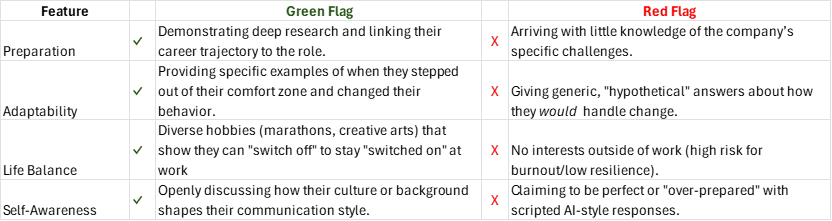
Culture Fit vs Culture Contribution
One of the most practical insights from this episode was the idea that “culture fit” can be vague and sometimes biased.
Every workplace has a culture, whether intentional or not. The better question is: Will this person help shape the culture our business needs next? As organisations grow, what they need from leaders changes too — new thinking, new capabilities, and different leadership behaviours.
So rather than hiring people simply because they feel like a good “fit”, the focus shifts to whether they’ll add value to the culture and help it evolve.
FInal Thought
Hiring is one of the most expensive investments you will make. By moving away from "gut feel" and toward a structured process , you protect your business from the hidden costs of unconscious bias. This three-step approach doesn't eliminate human judgment. Rather, it enhances it by providing the tools and framework needed to see beyond first impressions and rehearsed answers to understand who candidates truly are and what they'll contribute to your organisation's future success.